
The first money book for a child: what to look for, what to avoid
Choosing money books for children isn't about finding the fanciest cover. Here's what actually works when you want stories about saving money that stick.
October 12, 2026 · 7 min read
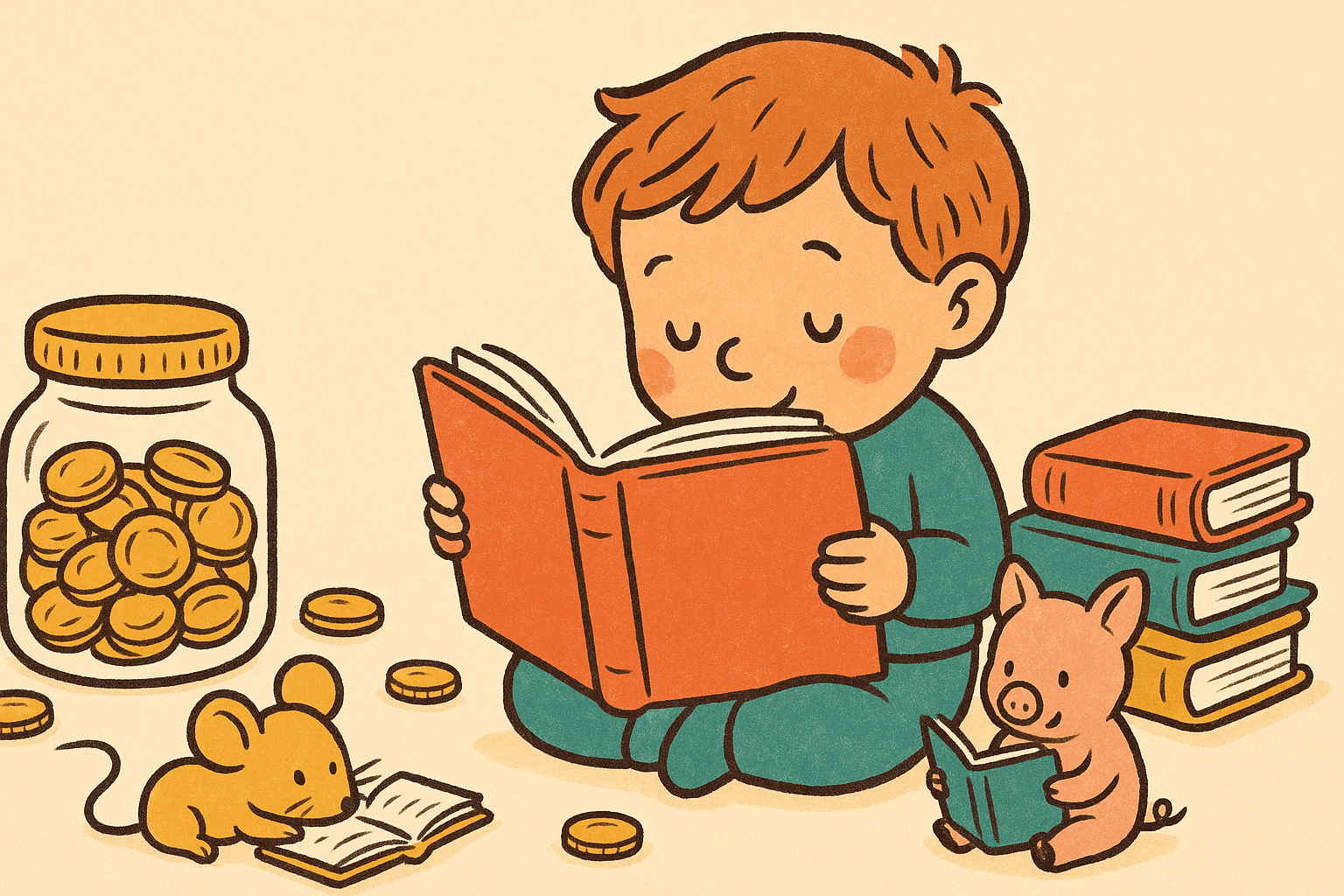
You're standing in front of a shelf of money books for children. Half of them have shiny coins on the cover. The other half feature animals holding piggy banks. You pick one up, flip through it, and… you're not sure. Will this actually teach anything? Or will your kid tune out after page two?
Here's the thing: the first financial literacy children's books your child reads set the tone for how they think about money for years. Choose well and you get curiosity, questions, maybe even a kid who wants to save up for something real. Choose poorly and you get a lecture disguised as a story, forgotten the moment you close the book.
So what separates the keepers from the duds?
The one thing every good money book for kids does (and most don't)
Most financial literacy children's books fail because they forget they're supposed to be books. They're lessons with pictures stapled on. The kid can feel it. The plot stops dead so a character can explain compound interest. The dialogue turns into a finance seminar.
The good ones? They tell a story first. The money part lives inside the plot. You don't notice the teaching because you're too busy wondering what happens next.
Take stories about saving money. The weak version: a child wants a toy, a parent says "save up," the child saves, the end. The strong version: the child wants something, faces a real temptation, makes a choice that costs them something, and then learns. The lesson isn't handed over. It's earned.
In Porfis Porfis Porfis, Leo wants everything now. He doesn't sit through a lecture on delayed gratification. He lives it. He watches his older sister save while he spends. He sees the difference. That's the whole point. The story does the work.
If you flip through a book and the characters sound like miniature accountants, put it back.
Age matters more than you think
A six-year-old and a nine-year-old live in different cognitive worlds. What clicks for one will bore or confuse the other. Most money books for children slap a "4-8" age range on the cover and call it done. That's too wide.
At four or five, kids barely grasp that money is a thing you trade for other things. They don't need investing analogies. They need: you can't have everything at once, choices have trade-offs, waiting sometimes gets you more.
At seven or eight, they're ready for slightly longer arcs. They can handle a character who wants two things and has to pick one. They can follow a simple save-spend-give framework.
By nine, they're asking harder questions. Why does one toy cost more than another? What if I want to save and spend? That's when stories about saving money need to get more textured. One choice, one consequence isn't enough anymore.
The sweet spot for a first money book? Four to six. Short enough to hold attention. Simple enough to grasp. Concrete enough to remember.
If the book has more than twelve pages of unbroken text, it's probably aimed too old. If every page is a single sentence, it's probably aimed too young. You want a middle.
What the pictures should actually do
Illustrations in financial literacy children's books aren't decoration. They're half the teaching tool. A kid who can't read yet still absorbs the whole story by following the pictures. If the art doesn't carry the plot, the book doesn't work for the youngest readers.
Look for expressions. Can you tell what the character is feeling without reading the words? If every face is a generic smile, the emotional beats won't land. Kids need to see the disappointment when a character spends too fast. They need to see the pride when someone reaches a goal.
Look for clarity. Is it obvious what's happening in each scene? Or do you have to squint and guess? Overly busy illustrations bog down the story. Too sparse and there's nothing to anchor the lesson.
In Vale la Pena, the pictures do serious work. You see Leo torn between two choices. You see the moment he realizes one thing matters more than the other. The words support the pictures, not the other way around.
Avoid books where the illustrations are photorealistic or overly abstract. The first style feels like a textbook. The second confuses young readers who are still learning to decode visual storytelling.
The three red flags that mean walk away
Some money books for children are technically fine but still miss the mark. Here's what to watch for.
First: the book solves the problem for the kid. A parent swoops in with extra money, or the toy goes on sale at the perfect moment, or a grandparent makes everything easy. That's not teaching. That's wish fulfillment. Real financial literacy means sitting with uncomfortable choices.
Second: the lesson is in the title. "Sammy Learns to Save." "The Waiting Game." If the whole moral is telegraphed before you open the book, there's no discovery. No surprise. No reason to care.
Third: money is the only thing characters talk about. Kids don't live in a world where every conversation is about dollars and cents. They live in a world where money comes up during other stuff—wanting a snack, planning a birthday, deciding between two activities. If the book treats money as the sole topic of existence, it's going to feel preachy.
Kay doesn't lecture Leo about budgets all day. She shows him how choices ripple outward. That's the difference.
What to do after you pick the book
Buying the book is step one. Reading it once is step two. But the real teaching happens in step three: talking about it.
Ask your kid what they would have done. Not "what did the character learn," but "what would you choose?" Let them argue for the opposite decision. Let them notice the details you missed.
Read it more than once. Financial concepts don't stick on a single pass. The first read is for the plot. The second is for the details. The third is where kids start connecting it to their own life.
Use it as a springboard. If the book is about saving for something big, ask your kid what they want to save for. If it's about choosing between two things, let them practice on a small real decision.
The best money books for children aren't magic. They're conversation starters. They give you a shared language. When your kid wants something expensive three weeks from now, you can say, "Remember what happened in the story?" and they'll actually remember.
A little today, a lot tomorrow.
More from the blog
Money conversations
Birthday money: what to do with what your kid receives
When kids get birthday money, you can turn it into a learning moment. Here's what to do with birthday money kids receive, without ruining the fun.
Family tips
Learning to wait: the patience behind saving
Teaching kids delayed gratification through everyday moments. Practical ways to help children build patience and understand why waiting makes rewards better.
Money conversations
Saying no to a purchase without guilt (and without drama)
Learn how to say no to a child asking for things with confidence and calm. Set money boundaries without tantrums or power struggles.