
Five coin games to play with your kid in ten minutes
Quick coin games for kids that teach counting, trading and patience. Grab a handful of change and play these five-minute math coin activities with your child.
September 9, 2026 · 4 min read
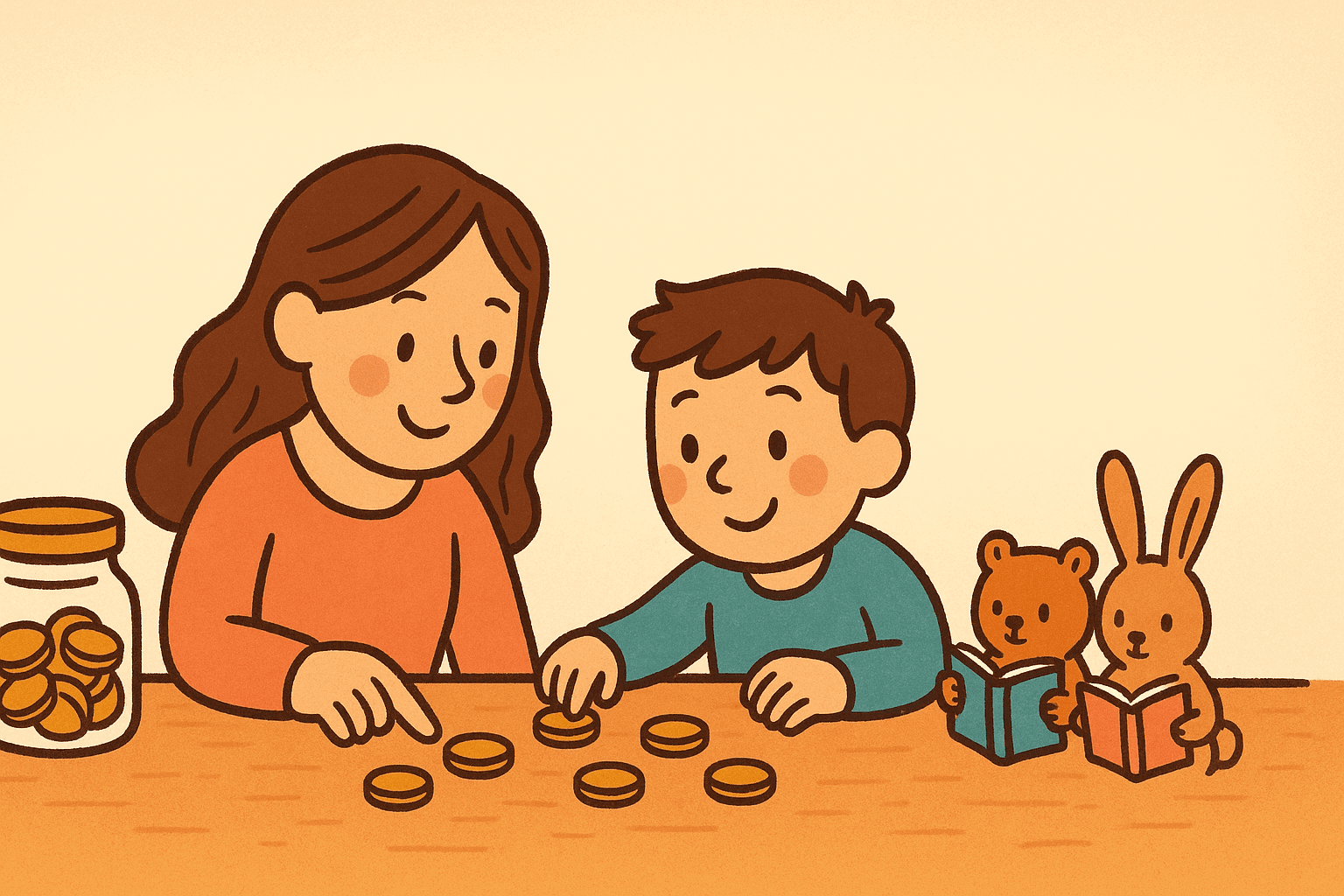
You have ten minutes before dinner. Your kid's bouncing off the walls. You spot a jar of coins on the counter.
Perfect.
Coin games for kids don't need fancy boards or long rules. A handful of change, a flat surface and a timer can turn any Tuesday into a mini money lab. These five games take less than ten minutes each, teach real skills (counting, comparing, delaying a choice) and end before anyone gets bored.
Coin Tower Race
Dump twenty coins on the table. Set a timer for three minutes. Each player stacks coins into the tallest tower they can build without it falling. Pennies work best at the base because they're wide. Dimes are trickier on top because they're thin.
Leo loves this one. He shouts "PLEASE!" every time his tower wobbles, as if begging the coins to stay put. Leo has learned that going slow beats going fast when balance matters.
Bonus round: once the tower falls, count the coins in it. Whoever stacked more coins (not taller, but more pieces) wins. This flips the strategy. Suddenly dimes and nickels become valuable because you can fit more in the same height.
Coin Flip Guess
One player hides a coin in a closed fist. The other guesses heads or tails. Flip it open. If the guesser's right, they keep the coin. If wrong, it goes back in the pile.
Play five rounds. At the end, the guesser counts their winnings. This game sneaks in a tiny probability lesson (it's always fifty-fifty) and practices mental addition as the pile grows.
Hani plays this with her eyes half-closed, pretending she can "sense" the coin's mood. She can't, but the drama keeps her interested long enough to count four nickels and realize that's twenty cents.
Trade Up Challenge
Start with ten pennies. The goal: trade up to a quarter using only fair swaps. Five pennies become one nickel. Two nickels become one dime. You need two dimes and one nickel to reach a quarter.
Set the coins in front of your kid. Say "Go." Let them figure out the path. Some kids move fast. Others, like Elio, check every trade twice to make sure they're not losing value.
This game mirrors the saving concept in Porfis Porfis Porfis. Little amounts combine into bigger ones if you're patient and intentional. No magic, just math.
Coin Pattern Copy
You make a pattern with five coins (penny, nickel, penny, dime, penny). Your kid studies it for ten seconds. Cover it with your hand. Now they recreate the pattern from memory using their own coins.
Start simple: three coins, same type. Then mix denominations. Then add spacing (close together vs. far apart). Each round builds memory and attention to detail.
Luna turned this into a two-player game where you take turns being the pattern-maker. Whoever copies the pattern correctly in fewer tries wins. She also started using quarter-turns (heads up, tails up) to make it harder, because Luna never leaves a game unmodified.
Coin Roll Toss
Draw three circles on a piece of paper, each the size of a fist. Label them 1 point, 5 points, 10 points. Stand three feet back. Toss coins onto the paper. Any coin that lands fully inside a circle scores that amount. Coins touching the line don't count.
Each player gets five tosses. Add up points at the end. Highest score wins.
This game teaches aim, counting in chunks (two fives make ten) and the emotional skill of watching a good toss bounce out at the last second. Enzo narrates his own tosses like a sportscaster: "And the nickel is in the air… will it land? IT DOES NOT." The drama helps him handle losing without a meltdown.
Why these work
Quick money games for children succeed when the rules fit on one breath and the materials live in your pocket. Coins are better than play money because they have weight, they stack differently and they feel real. A dime is smaller than a penny but worth more. That physical contradiction sticks in a kid's brain longer than any worksheet.
These math coin activities also end fast. You're not committing to a half-hour operation. You're filling a gap: the wait for the oven timer, the lull after homework, the moment when you need your kid's hands busy so their brain can settle.
Kay once told Leo that the best practice doesn't feel like practice. It feels like a game somebody actually wants to play again tomorrow. That's the test. If your kid asks "Can we do the coin tower thing after breakfast?" the game passed.
You can rotate through all five games in a week, pick a favorite or invent your own version. The important part is the ten minutes of sitting next to each other, handling real money and learning that math isn't a subject that lives only in school. It lives on the kitchen table, in a pile of loose change, in the three minutes before the pasta's done.
Want more hands-on options? Check out games you can start right now with what's already in your house.
A little today, a lot tomorrow.
More from the blog
Activities at home
Saving toward a goal with your kid: how to guide without pushing
Learn how to teach a kid to save for a goal without nagging. Practical ideas for purposeful saving that keep curiosity alive and build real habits.
Activities at home
How to make a homemade savings jar with your kid (step by step)
Learn how to make a savings jar for kids using things you already have at home. A fun craft that teaches money habits while you build together.
Activities at home
The transparent jar - the first savings tool for kids ages 4 to 9
Why a glass jar teaches more about saving than a thousand explanations, how to set up the ritual at home, and what to do when your kid wants to open it too soon.