
Playing shop at home: the best game to learn how to pay
Turn your living room into a pretend play store for kids. A simple money game that teaches paying, counting, and choosing without a single worksheet.
October 21, 2026 · 6 min read
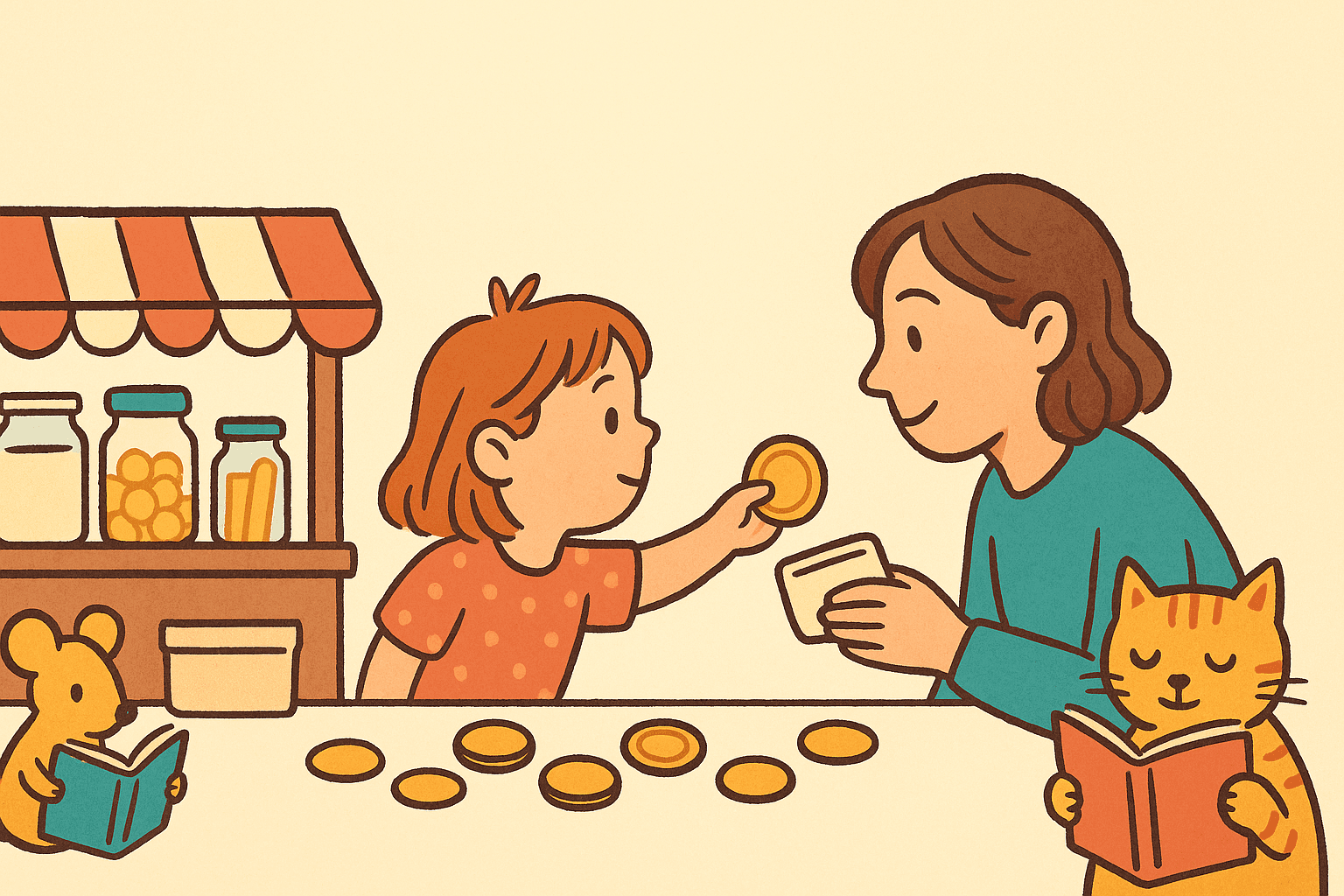
Leo stands behind a cardboard box turned on its side. Three stuffed animals sit in a row. A plate with four crackers. A cup holding three crayons. A toy car. He's holding a wooden spoon like a microphone.
"Welcome to Leo's Super Store! Everything costs one button!"
Hani walks up. "I'll take the car, please."
Leo looks at her empty paws. "That'll be one button."
Hani pats her fur. "I don't have any buttons."
Leo frowns. "Then no car."
Kay steps in, drops a pile of buttons on the counter. "Here. Now we can all shop."
That's how it starts. A pretend play store for kids that needs nothing fancy, just a corner of the room and a handful of small objects. No app, no screen, no printable PDles from a teacher blog. The kind of game where Leo learns to count, hand over payment, wait for change, and realize he can't buy everything at once.
Why shop play works better than worksheets
Most money lessons for young kids involve pointing at coins on a page. This one is worth five cents. This stack is worth ten. Circle the right answer. Done.
But a play store money game puts the whole transaction in motion. You pick the item. You count out the payment. You hand it over. You wait. You get the item or you don't. That sequence matters. It's the same sequence they'll use in a real store, minus the part where a tired parent says "just pick something already."
Leo sets up his store every weekend now. Sometimes everything costs one button. Sometimes crackers cost two buttons and the toy car costs five. Sometimes he runs out of crackers and Hani has to choose the crayons instead. Each version teaches a different piece. Scarcity. Counting. Choosing when you can't have both.
Kay watches from the side, only stepping in when Leo tries to charge Hani seven buttons for a single cracker. "Is that fair?" Kay asks. Leo thinks. Adjusts the price. Keeps playing.
No lecture. Just the game working itself out.
How to set up a pretend store in ten minutes
You don't need a toy cash register. You don't need printed money. You need a flat surface, a small collection of items, and something to use as currency. Buttons work. Dry beans work. Small stones from the garden work. Anything you can count and hand over.
Pick five to eight items. Toys, snacks, crayons, small books. Line them up. Assign prices. Start simple. Everything costs one button, or everything costs two. Let the kid behind the counter set the rules. They'll get wild with pricing soon enough.
One player is the shopkeeper. The others are customers. Each customer gets a small pile of buttons. They browse. They choose. They count out payment. The shopkeeper counts it again. If it's right, the customer gets the item. If it's wrong, they try again.
That's it. The whole setup takes less time than finding the remote.
After a few rounds, switch roles. Let the kid who was buying become the seller. They'll spot counting mistakes they missed when they were on the other side of the counter. They'll start checking their own math before handing over buttons. That's the mechanic doing its job.
What happens when they run out of buttons
This is the best part. Leo comes up to the counter. He wants the toy car. The car costs three buttons. He has two.
"Can I have it anyway?"
Hani, now running the store, shakes her head. "You need three."
"But I reeeally want it."
"Then you have to wait and get more buttons."
Leo sits down. He looks at his two buttons. He looks at the car. He looks at the pile of buttons Kay is holding for the next round. "Can I have one more button, Kay?"
Kay hands him a button. "Now you have three. What are you going to do?"
Leo runs back to the counter. Buys the car. Plays with it for ten seconds. Looks back at the store. "I want the crackers too."
"You spent all your buttons," Hani says.
Leo pauses. This is the moment. He just learned he can't buy everything. Not because someone told him. Because the game has a floor.
That's learning to pay through play. No moral at the end, no poster on the wall. Just the experience of running out and having to choose.
When to add prices, change, and budgets
Start with flat pricing. Everything one button. Once they've done that five or six times, mix it up. The car costs three. The crackers cost one. The crayons cost two. Now they have to decide if they want one expensive thing or several cheap things.
After a week or two, introduce change. Customer hands over four buttons for a two-button item. Shopkeeper has to give two buttons back. This is where most kids stall. Counting forward is easy. Counting backward is hard. Let them struggle a bit. Let them recount. Let the other player check their work. They'll get it.
Once change is solid, give each customer a budget. "You have five buttons total. Buy what you want, but when they're gone, they're gone." Now it's not just about whether they can pay for one item. It's about what they can afford across the whole trip. That's the same skill they'll need at a real store, a yard sale, or the school book fair.
The games section has a few more twists you can add, but these three stages cover the first month of play. Flat pricing. Mixed pricing. Change and budgets. Each one builds on the last.
What this game teaches that a piggy bank doesn't
A piggy bank teaches saving. Drop the coin in, hear the clink, feel good. Important skill. But it doesn't teach the next part, which is spending. Choosing what to spend on. Deciding if you have enough. Handling the moment when you don't.
A pretend play store for kids teaches the whole loop. You have money. You want something. You check the price. You count. You hand it over. You either get the thing or you don't. If you don't, you figure out what to do next. Wait, choose something cheaper, ask for help, earn more buttons.
That's the loop they'll use for the rest of their lives. It starts here, in the living room, with a cardboard box and a pile of buttons.
Leo's store is still running. He's added new rules. Now you can trade items back for half the buttons. Now there's a discount shelf. Now Hani runs a competing store across the room and they're in a price war. Kay stepped back weeks ago. They don't need a referee anymore. They've got the mechanic down.
It's the same mechanic they'll see in The Lemonade Stand Stand-Off, just played out in three dimensions with real counting and real consequences. No one's getting a grade. No one's filling out a chart. They're just playing, and the math is happening in the background like it's supposed to.
A little today, a lot tomorrow.
More from the blog
Activities at home
A lemonade stand: your kid's first business step by step
Turn a kids lemonade stand into real learning. Planning, pricing, and counting change—Kay & Leo™ make the first business for kids unforgettable.
Activities at home
Three jars: save, spend and share explained to a child
Learn how save spend share jars help kids practice smart money habits through hands-on play. A three jar money system your family can start today.
Activities at home
Money crafts to make with your kid on the weekend
Turn cardboard and paint into money crafts for kids that teach saving, spending and giving. Real projects, real learning, zero lecture.