
A lemonade stand: your kid's first business step by step
Turn a kids lemonade stand into real learning. Planning, pricing, and counting change—Kay & Leo™ make the first business for kids unforgettable.
October 23, 2026 · 7 min read
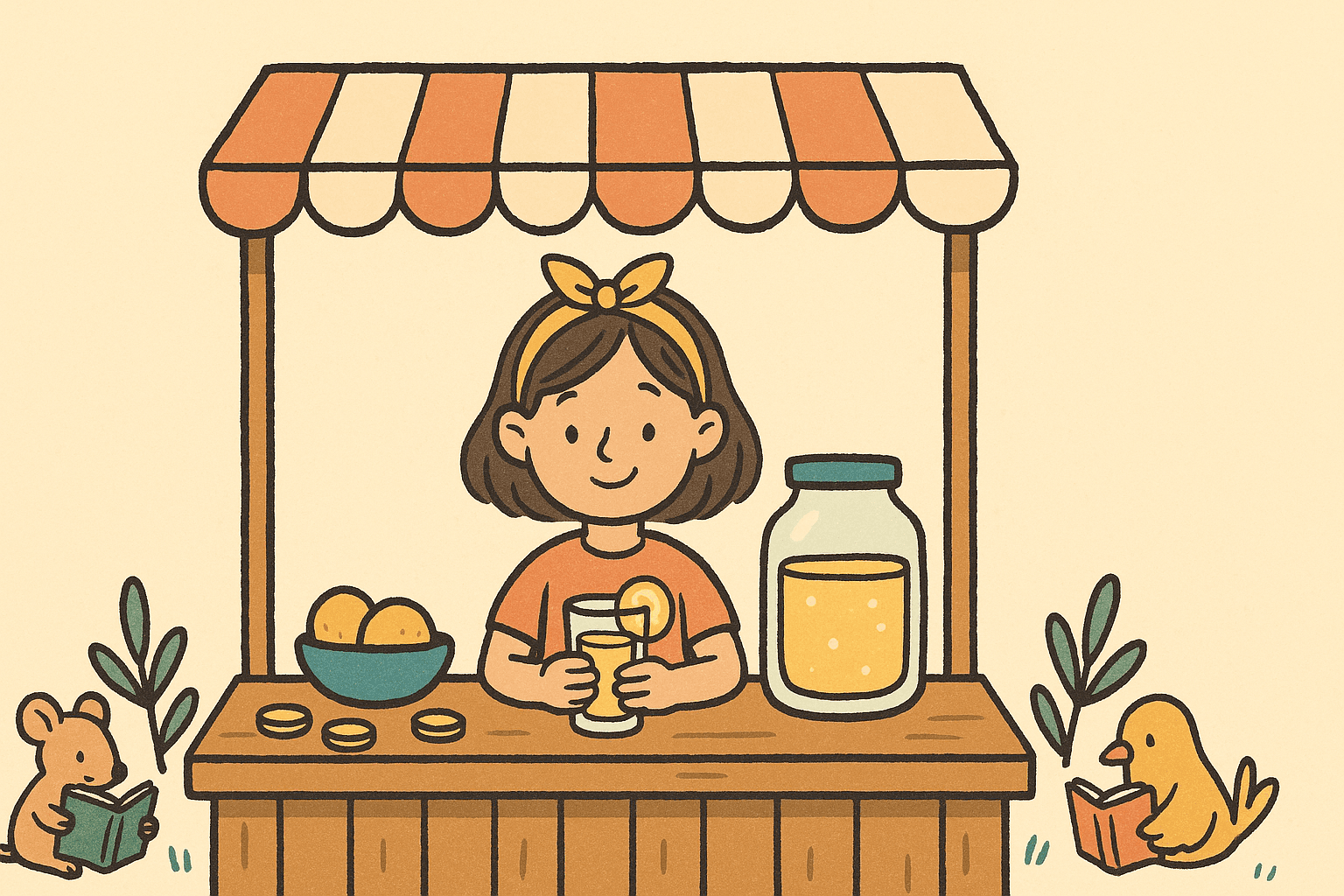
A pitcher of lemonade. A wobbly table. A hand-painted sign that may or may not spell "lemonade" correctly. If you've ever watched a child hawk cups of something vaguely citrus on a Saturday afternoon, you know the magic and the mess. A kids lemonade stand is loud, sticky, and more educational than any lecture you could give on money.
It's also the perfect first business for kids. You don't need a business plan or a tax ID. You need lemons, ice, a sharpie, and enough patience to watch them sell four cups in two hours while declaring themselves rich.
Let's walk through it. No fluff. Just the steps that turn curiosity into coins and chaos into competence.
Why a lemonade stand beats a piggy bank speech
Talking about money in the abstract doesn't stick. Saying "save for the future" means nothing when the future is next Tuesday. But handing over a dollar bill for something they made? That lands.
A lemonade stand gives kids three things at once: cause, effect, and consequence. They see the cost of supplies. They watch people decide whether to buy. They count what's left at the end. No middleman. No delay. Just immediate, tangible feedback.
Leo learned this the hard way when he tried to charge ten acorns per cup and wondered why nobody stopped. Pricing, as it turns out, is not about what you want. It's about what the market will bear. And the market—in this case, neighbors on a walk—has opinions.
Kid entrepreneurship doesn't require a storefront. It requires one brave moment when they realize: I made this, and someone paid me for it. Everything else is details.
Step one: the budget talk (yes, really)
Before you buy a single lemon, sit down and do the math together. This is not a parent-funded gift shop. This is a business. That means they need to know how much things cost and what happens if they run out of money before they run out of thirst.
Start with a number. Ten dollars is plenty. Write it down. Then make a list: lemons, sugar, cups, ice, poster board, markers. Look up prices if you need to. Add it up. If it's over budget, they cut something or find a cheaper option.
This is the moment where most kids realize that "free" lemonade at home is a lie. Someone paid for those lemons. Someone paid for that sugar. Now they're that someone.
Kay calls this "the invisible cost." It's invisible until you're the one writing the check. Then it's very, very visible.
If they want to get fancy—a cooler, a tablecloth, a bell to ring when someone buys—they can. But it comes out of the budget. Every choice has a trade-off. That's the lesson hiding under the lemon zest.
Step two: build the stand (function over flair)
You do not need carpentry skills. You need a flat surface, a sign, and a way to keep the lemonade cold. A folding table works. A cardboard box works. The tailgate of a parked car works if you're feeling bold.
The sign matters more than you think. It's the first thing people see. If it says "Lemonaid" with a backwards "n," that's fine. Charm counts. But it should be big, readable, and include the price. Nobody wants to ask. Make it easy.
Let them design it. Let them spell it wrong. Let them draw a lemon that looks like a lumpy sun. The point is ownership. If they made it, they'll defend it. If you made it, they'll shrug when it tips over.
Decoration is optional. Plastic flowers, a radio playing pop songs, a tip jar shaped like a frog—knock yourself out. But the stand works without it. Function first, flair second. You're selling lemonade, not an aesthetic.
Step three: the first customer (and the fear)
This is where it gets real. Someone walks up. Your child freezes. Their voice drops to a whisper. They forget the price. They pour too much. They spill. They hand over the cup and forget to take the money.
All of this is normal. The first transaction is terrifying. They are asking a stranger to give them money for something they made. That takes guts.
Stay close but stay quiet. Let them fumble. Let them recover. If they need a prompt ("How much is it again?"), give it. But don't take over. This is their deal, not yours.
After the first sale, something shifts. They did it once. They can do it again. By customer three, they're negotiating. By customer five, they're upselling. ("Want two cups? It's faster.")
The lemonade stand stand-off taught Leo that hesitation costs sales. While he was rehearsing his pitch in his head, Enzo sold six cups with nothing but volume and confidence. Lesson learned: done beats perfect.
If you want to practice sales skills before the big day, try one of the games that involve pretend stores or trade. Low stakes, high repetition. By the time the stand opens, the script feels automatic.
Step four: counting the money (the real win)
At the end of the day, dump everything on the table. Bills, coins, sticky quarters, a button someone thought was a nickel. Count it together. Out loud. Slowly.
First, subtract the cost of supplies. What's left is profit. This is the number that matters. Not revenue. Not sales. Profit.
If they made twelve dollars and spent eight, they have four dollars. Not twelve. Four. That four dollars is theirs because they earned it, but only after they covered what it cost to earn it.
Some kids are thrilled. Some kids are confused. ("Wait, I only get four?") Both reactions are valid. Both are teachable moments.
Ask what they'll do with the profit. Save it? Spend it? Make a better stand next time? There's no wrong answer, but the question itself plants a seed. Money isn't magic. It's a tool. Tools work better when you know what you're building.
What happens after the stand comes down
The lemonade stand doesn't end when you fold up the table. It ends when they decide whether to do it again. Some kids run one stand and call it done. Some kids want to expand into cookies, bracelets, or custom art. Some kids never want to see a lemon again.
All of that is fine. The goal was never to create a mogul. The goal was to show them that earning, spending, and choosing are connected. That money comes from effort. That effort has a price, and so does everything else.
If they want to run it again, let them fund it themselves this time. They made profit. They can reinvest it or start from scratch. That's the next lesson: growth requires risk.
If they're done, great. They learned what they needed. A first business for kids isn't about building an empire. It's about building confidence. The kind that says: I tried something hard, and I didn't quit.
A little today, a lot tomorrow.
More from the blog
Activities at home
Playing shop at home: the best game to learn how to pay
Turn your living room into a pretend play store for kids. A simple money game that teaches paying, counting, and choosing without a single worksheet.
Activities at home
Three jars: save, spend and share explained to a child
Learn how save spend share jars help kids practice smart money habits through hands-on play. A three jar money system your family can start today.
Activities at home
Money crafts to make with your kid on the weekend
Turn cardboard and paint into money crafts for kids that teach saving, spending and giving. Real projects, real learning, zero lecture.