
How to talk to kids ages 4 to 9 about money (without giving them the lecture)
A practical guide to starting real money conversations with young kids using stories, real coins, and simple questions. No formal lessons, no anxiety, no perfect-family budgeting required.
August 5, 2026 · 6 min read
Explaining money to a five-year-old shouldn't need a slide deck. But when the first real question lands ("why can't I have that?", "how much do you earn?", "does money run out?"), most parents freeze. We weren't really taught this as kids and now we're expected to handle it in a checkout line.
A lot of the work is done by the story itself. A book like Please, Please, PLEASE, Can I Have It? introduces saving and patience without the word "lesson" ever showing up. The rest is five or six short lines you can drop into an ordinary day.
Under 6, money is physical
Between 4 and 6, money is a thing with weight. Coins clink. Jars fill up slowly. Waiting costs. At that age, big numbers and percentages don't land. What lands is what a child can see and hear.
Three things work here.
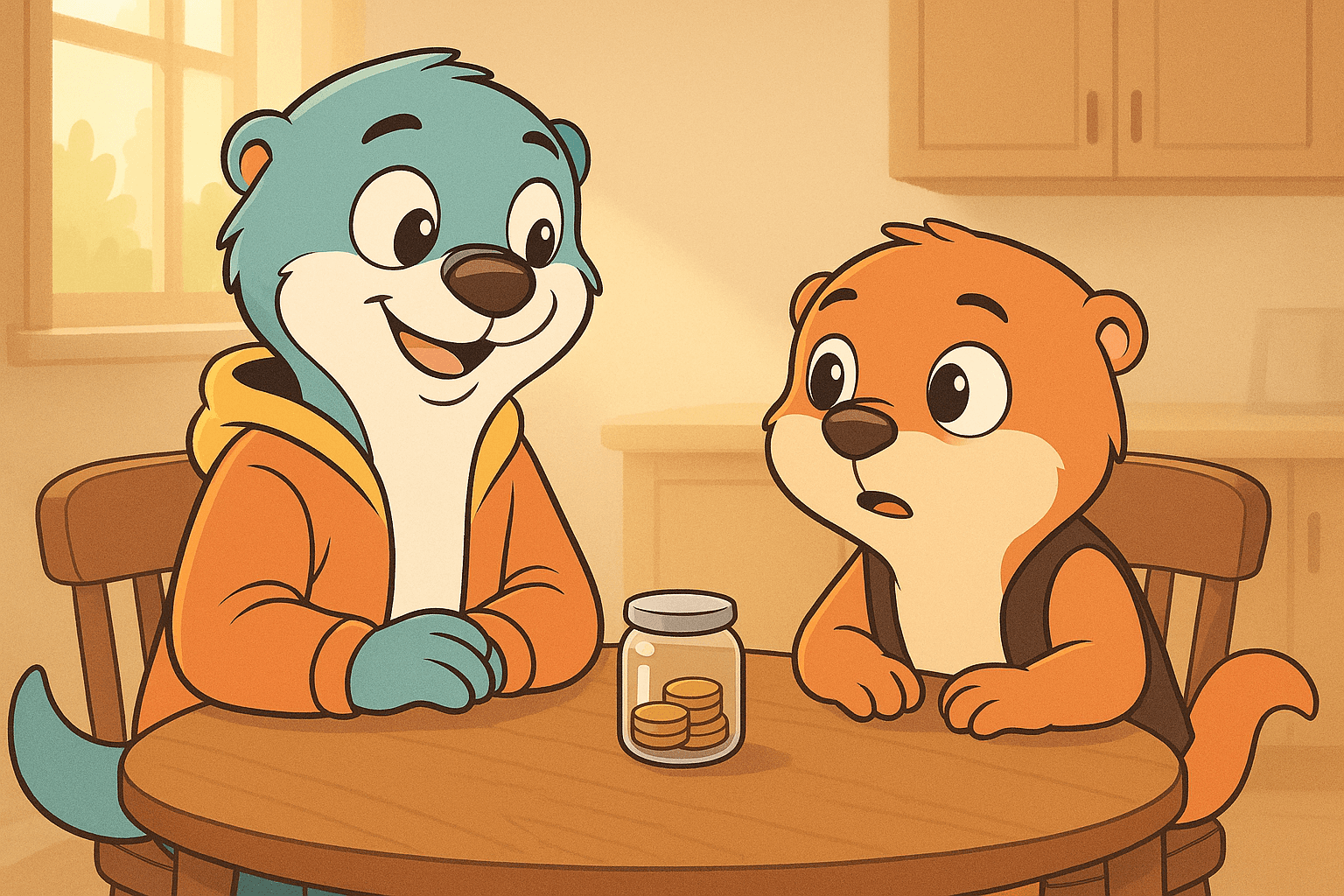
A clear glass jar. When saving becomes visible, money stops being abstract. It's the first thing Kay teaches, the only one in the group who teaches the money lesson, and it's what Leo learns the hard way, shaking his jar every ten minutes to check.
Naming the wish, not the number. "The scooter" is more useful than "thirty dollars". The number will come later on its own and by then it will have context.
Saying "not today" plainly. "We have no money" builds anxiety. "Not today" teaches that choices exist. Kids accept an honest no far better than a dressed-up one.
Ages 6 to 9, money is a decision
Now you can talk about choosing. Not budgeting (that's later) but noticing that every purchase blocks another one. Kay's household question for this is short:
"Wow… or worth it?"
It works in a store, in front of a catalogue, when an ad pops up on a phone. There's no wrong answer, just practice. Over time the kid starts asking it themselves, and that's the only "lesson" they need at this age.
Five lines for the every-day
- "Want or need?" — Distinguishes without drama.
- "Where would the money come from?" — Introduces the idea of source without a lecture on adult work.
- "If we wait, would you still want it?" — Patience is proven, not preached.
- "This one or that one?" — Choosing is easier than sacrificing.
- "Show me what you've saved." — Recognising effort before adding anything new.
None of these sound like class. They all let the child think out loud.
What not to do
Don't turn every purchase into a teaching moment. The systematic lecture is what breaks the conversation. If you covered it this week, let it rest.
Don't lie about scarcity. Dramatising "we have no money" when it isn't true builds insecurity. Simple honesty ("it isn't in this month's plan") works better.
Don't compare with "when I was your age". Kids don't process that framing; they just hear that they did something wrong.
Don't promise big rewards for small wins. The goal is for saving to feel normal, not like a feat that gets paid separately.
A weekly ritual
Pick one fixed day. In our house (and in Kay and Leo's) it's Saturday morning, when nobody is rushing. Three steps.
Take the jar out and count what's there, out loud. No new money yet.
Name the wish. Is it the same, has it changed, does it still matter.
Choose one small spend or save for the week. Not a contract; a game.
Ten minutes, no screens, no notebooks. You learn a lot about a five-year-old when you let them decide where the next coin goes.
And if I explain something wrong?
You're fine. Every kid watches the grown-ups get money wrong; it's part of the training. What they remember isn't the technically correct answer. They remember that you were willing to talk about it without getting tense.
A little today, a lot tomorrow.
More from the blog
Money conversations
The value of money for a five-year-old: what they get and what they don't
Teaching a 5 year old the value of money starts with concrete swaps, not abstract lessons. What works at this age and what can wait.
Money conversations
Wants vs needs: how to teach it to a child without lecturing
How do you teach wants vs needs for kids without the eye rolls? Concrete examples, fun activities, and zero sermons.
Money conversations
What to say when your kid asks for something expensive at the store
Practical scripts for talking to kids about price when they want an expensive toy. Turn the store tantrum into a calm money conversation with your child.