
Money crafts to make with your kid on the weekend
Turn cardboard and paint into money crafts for kids that teach saving, spending and giving. Real projects, real learning, zero lecture.
September 25, 2026 · 5 min read
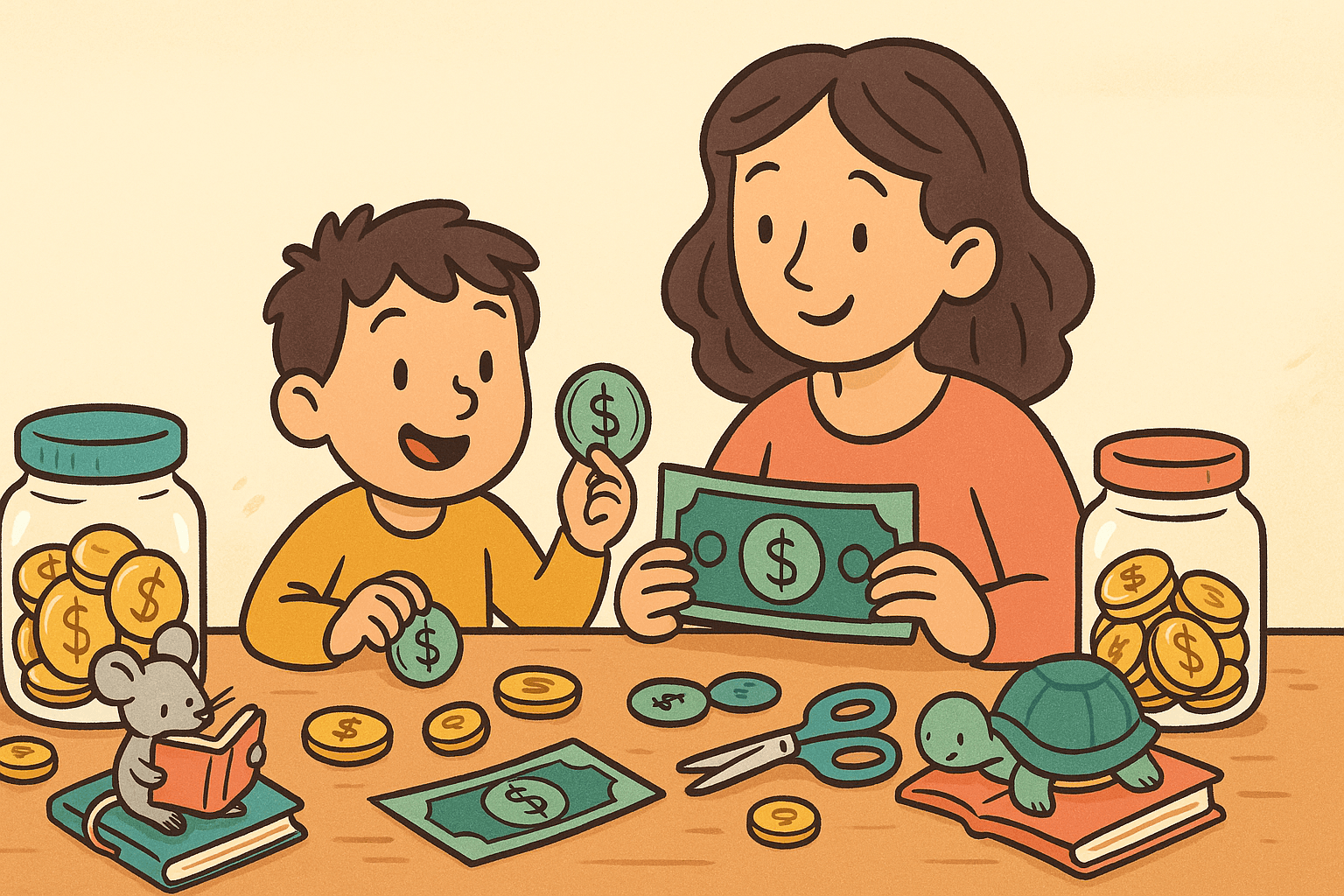
Leo spent last Saturday morning building a coin sorter out of cereal boxes. It wobbled. It had tape everywhere. And when he dropped in his first coin, it clattered straight through the bottom onto the floor.
He looked at Luna, who was adjusting the angle with a protractor she'd drawn herself.
"Try again," she said.
They rebuilt it. This time the coin rolled down the chute, bounced off a cardboard flap, and landed in the right cup.
Leo's eyes went wide. "It worked!"
That's the power of money crafts for kids. You're not lecturing about percentages or interest rates. You're handing them scissors, glue and a challenge, and letting them figure it out with their hands.
Why weekend kids money projects beat another screen day
Most financial literacy content for children sits in one of two buckets. Either it's a workbook full of word problems (boring), or it's a app that gamifies saving with cartoon coins (fine, but abstract).
Crafts live in the middle. They're tactile. They take time. And when a kid decorates a savings jar with marker and glitter, that jar becomes theirs. It's not a generic piggy bank from the store. It's the one they made, which means they'll actually use it.
Plus, weekend mornings need structure. If you don't plan something, you'll wake up at 10 a.m. to find your kid three episodes deep into a show you've never heard of. A craft gives you two hours of focused activity, a snack break in the middle, and something concrete to show at the end.
Luna taught the group this rule: "If you can't touch it, you can't improve it." She was talking about her inventions, but it applies to money habits too. A chart on the wall is better than a lecture. A coin sorting game is better than a chart. A cardboard bank you built yourself is better than all of it.
Three money crafts that actually teach something
Start with a give-save-spend sorting box. You need one shoebox, cardboard dividers, and three labels. Cut slots in the lid above each section. When your kid gets allowance or birthday money, they drop coins through the slots and watch them pile up in different compartments.
The lesson isn't in the construction (though measuring and cutting teach spatial reasoning). The lesson is in the daily habit. "I got two dollars. Where does it go?" Over time, they see the give section fill slower than save, and that sparks the conversation about percentages without you having to explain percentages.
Next, try a goal tracker poster. Take a sheet of poster board and divide it into boxes, one for each week until the goal date. If your kid wants a toy that costs twenty dollars and gets two dollars a week, that's ten boxes. Each week they add a sticker or color in a box.
This one teaches delayed gratification in a format their brain can process. "Ten weeks" is abstract. Ten empty boxes on the wall is concrete. Leo used this method to save for a telescope (he got to box seven and changed his mind, but that's also a lesson).
Third, build a spend-or-save spinner. Cut a circle from cardboard, divide it into four sections, and label them: save, spend, give, and "ask Kay." Poke a brad through the center and attach a spinner arrow. Every time your kid wants to buy something small, they spin first.
It's silly. It's random. And that's the point. The spinner forces a pause between impulse and action. Sometimes it lands on "save" and they groan but follow the rule. Sometimes it lands on "spend" and they feel like they won the lottery. Either way, they're internalizing the idea that not every dollar has to go the same direction.
You can find printable templates for all three projects in our crafts section, along with variations for different age ranges.
How to keep it light (so they'll actually want to do it again)
The biggest mistake parents make with children craft about saving is over-explaining while the glue is still wet. You're mid-project, your kid is focused on cutting a straight line, and you launch into a speech about compound interest.
They tune out. The craft becomes homework.
Instead, let the craft do the talking. Build the thing first. Use it for a week. Then, when they notice the save jar filling up faster than the spend jar, that's when you say, "Huh, interesting. Why do you think that happened?"
Elio's method: "Make it, test it, talk about it later." He's a turtle, so he's naturally patient. But the principle works. If you rush the lesson, you kill the curiosity.
Also, let them customize everything. Luna's coin sorter had gears drawn on the side (they didn't move, but they looked cool). Enzo painted his savings jar to look like a stage with velvet curtains. Cris built a goal tracker shaped like a construction site, with each box representing a finished building.
The uglier and weirder it looks, the better. That means they made it, not you.
And if the project fails halfway through (Leo's first coin sorter, Ania's spinner that spun too fast and flew off the brad), don't fix it for them. Say, "That's annoying. What do you think went wrong?" Problem-solving is the hidden lesson in every craft.
What happens after the weekend ends
The real test of any children craft about saving isn't how it looks on Saturday. It's whether your kid still uses it on Wednesday.
Most projects die in a drawer. To avoid that, put the finished craft somewhere visible and functional. The sorting box lives on their dresser. The goal tracker goes on the wall next to their bed. The spinner sits in the kitchen, next to where you keep the allowance.
And keep it active. Every Sunday night, check the sorting box together. Count the coins in each section. Move any extra from "spend" into "save" if they didn't use it. Update the goal tracker. These tiny rituals turn a one-time craft into a money habit that sticks.
In Porfis, porfis, porfis, Kay teaches Leo that saving isn't about saying no to everything. It's about choosing what matters. A craft project teaches the same lesson, but backward. Instead of talking about the concept and hoping it sinks in, you hand them the materials and let them build the concept with their hands.
That's why it works. And why, three weeks later, when Leo wanted to buy a comic book, he checked his sorting box first, saw the save section was full, and said, "Maybe next week."
No lecture. Just a box he made, doing its job.
A little today, a lot tomorrow.
More from the blog
Activities at home
A lemonade stand: your kid's first business step by step
Turn a kids lemonade stand into real learning. Planning, pricing, and counting change—Kay & Leo™ make the first business for kids unforgettable.
Activities at home
Playing shop at home: the best game to learn how to pay
Turn your living room into a pretend play store for kids. A simple money game that teaches paying, counting, and choosing without a single worksheet.
Activities at home
Three jars: save, spend and share explained to a child
Learn how save spend share jars help kids practice smart money habits through hands-on play. A three jar money system your family can start today.