
What to say when your kid asks for something expensive at the store
Practical scripts for talking to kids about price when they want an expensive toy. Turn the store tantrum into a calm money conversation with your child.
September 2, 2026 · 5 min read
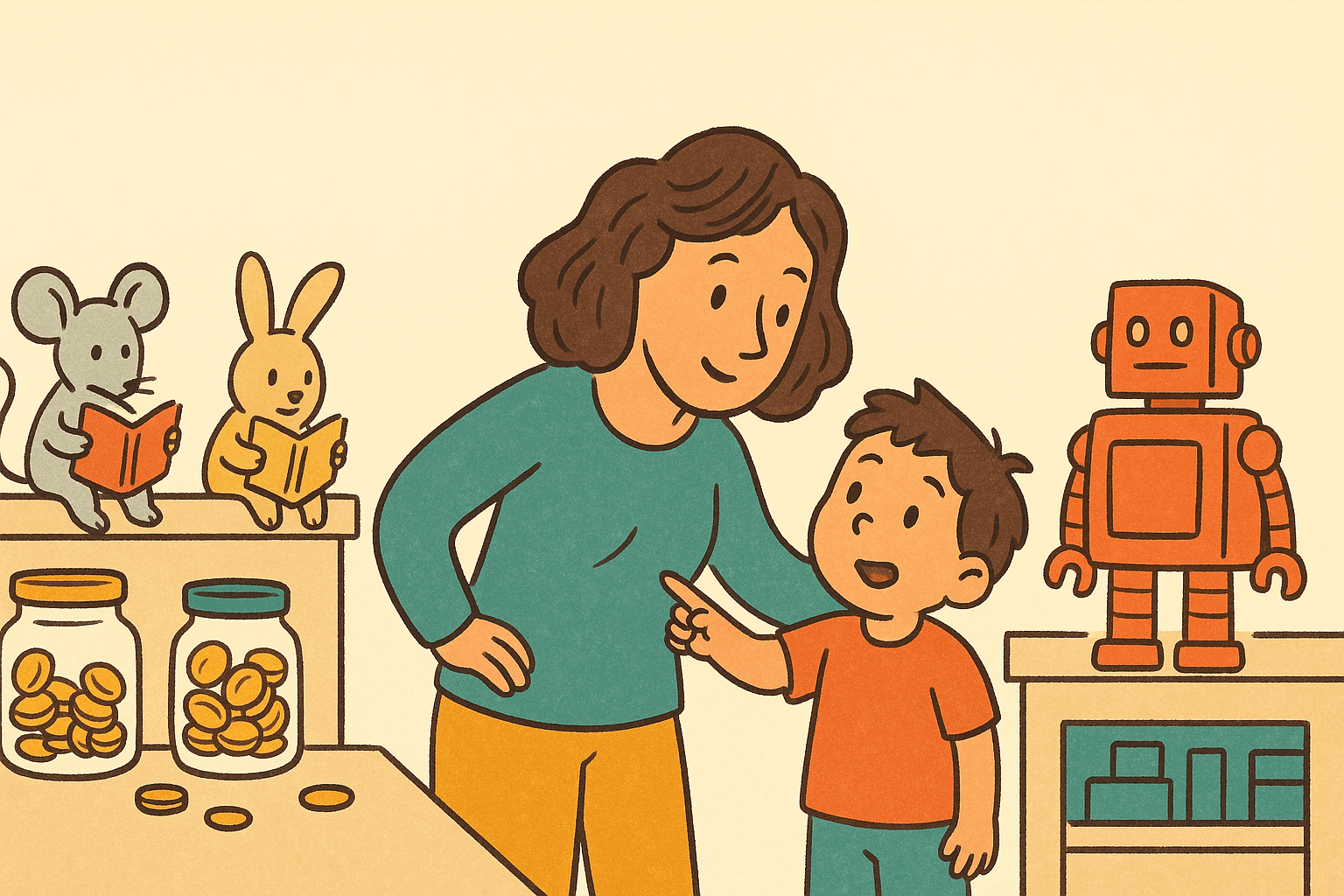
The toy aisle. Your kid spots a giant robot that costs more than your grocery budget. "I want it!" You feel the eyes of other shoppers. Your brain scrambles for the right words.
You're not alone. Every parent faces this moment. The good news? You don't need a perfect answer. You need a few simple phrases that respect your child's feelings and teach something real about money.
Start with what they see, not what you fear
When Leo wants something big, his first instinct is to say "PLEASE!" louder. When that doesn't work, tears might come next. But here's what happens before the meltdown: he genuinely believes the thing he wants is the most important thing in the world right now.
So start there. "You really like that robot. I see why. Look at those lights." Name what caught their attention. This takes ten seconds and cuts the emotional volume in half. Your child feels heard. You buy yourself space to think.
Then pause. Literally pause. Let them look at it for another moment. This isn't stalling. You're teaching them that wanting something and buying something are two separate events. That gap matters.
Use the price tag as a teacher
Most kids under seven don't know what numbers mean in the real world. "Eighty dollars" is just sounds. So make it concrete.
"This toy costs eighty dollars. That's about the same as eight times at the ice cream shop. Or four new books. Or what we spend on groceries for three days."
Pick a comparison that fits your family. The point isn't to shame anyone for the price. It's to show that money does specific things. When we spend it here, we can't spend it there. That's not a moral lesson. It's just how it works.
If your child is older, you can add: "We have a budget for toys this month. We already used it." Budget is a real word they'll hear forever. Start now. It means we made a plan, and the plan helps us do the things that matter most.
Offer a real choice, not a fake one
Don't say "maybe later" if you mean no. Kay teaches Leo that honesty builds trust. If the answer is no, say it plainly and with warmth. "We're not buying this today. I know that's disappointing."
But if there's flexibility, give them a path. "This isn't in our plan for today. But if you still want it in two weeks, we can talk about saving for it together." Then follow through. Write it down. Let them see you take it seriously.
Some families use a photo trick. Take a picture of the toy with your child holding it. Say, "Let's keep this so we remember." Half the time, they forget about it by dinner. The other half, you have a record of something they truly want. That photo becomes the start of a saving conversation, not a guilt trip.
Another option: "You can use your own money if you brought it." If they have a few dollars in their pocket and the toy costs forty, they'll do the math themselves. They'll feel the gap. That's a lesson no lecture can teach.
Name the feeling without fixing it
Your child might cry. They might say it's not fair. They might go limp in the aisle. You haven't failed. They're learning that disappointment is survivable.
"I know you're sad. It's hard to want something and not get it." Stop there. You don't need to add, "But you have so many toys at home," or "There are kids who have nothing." Those statements might be true, but they don't help a four-year-old regulate their nervous system in aisle five.
Kay never rushes Leo's feelings. She waits. She stays close. She reminds him that the feeling will pass and they'll figure out what to do next.
If you need to leave the store, leave. There's no award for enduring a full meltdown under fluorescent lights. You can finish the lesson at home when everyone's calm.
Build the habit before the crisis
The best time to explain why not buying something is weeks before the expensive ask. Talk about money when you're not in the middle of wanting.
In Porfis, Porfis, Porfis, Kay and Leo go through this exact situation. Leo wants everything. Kay shows him what saving looks like, what choosing looks like, what waiting looks like. The story gives you a script you can return to: "Remember when Leo wanted that toy? What did Kay say?"
Read it together on a Tuesday night. Then when Saturday comes and your kid spots the expensive thing, they've already seen the map. They know the words. They might still be disappointed, but they won't be confused.
You can also practice in low-stakes moments. At the library, let them pick two books, not ten. At the park, say it's time to go even if they want five more minutes. Small nos build the muscle for big nos. They learn that limits aren't punishment. They're just part of how the world works.
What to skip
Don't say, "We can't afford it," unless that's precisely true and you're ready to explain what afford means. Most of the time, it's not that you can't. It's that you're choosing not to. Own that.
Don't say, "Maybe for your birthday," unless you'll remember in six months. Kids have long memories for promises about toys.
Don't lecture about gratitude in the moment. Gratitude is real and worth teaching, but not when your child is flooded with longing. Teach it later, when their brain can actually listen.
And don't feel like you have to justify yourself to strangers. The person giving you a look in the checkout line isn't raising your kid. You are.
Try it once, then adjust
No script works for every child or every moment. Some kids respond to logic. Some need a hug first. Some need to be removed from the situation before any words will land. Talking to kids about price is a skill you build one conversation at a time.
What matters is that you're thinking about it. You're not just saying no and walking away. You're not just saying yes to end the discomfort. You're teaching your child that money is a tool, that choices have trade-offs, and that wanting something doesn't mean you get it right now.
That lesson will serve them long after the robot is forgotten.
A little today, a lot tomorrow.
More from the blog
Money conversations
The value of money for a five-year-old: what they get and what they don't
Teaching a 5 year old the value of money starts with concrete swaps, not abstract lessons. What works at this age and what can wait.
Money conversations
Wants vs needs: how to teach it to a child without lecturing
How do you teach wants vs needs for kids without the eye rolls? Concrete examples, fun activities, and zero sermons.
Money conversations
How to talk to kids ages 4 to 9 about money (without giving them the lecture)
A practical guide to starting real money conversations with young kids using stories, real coins, and simple questions. No formal lessons, no anxiety, no perfect-family budgeting required.