
The value of money for a five-year-old: what they get and what they don't
Teaching a 5 year old the value of money starts with concrete swaps, not abstract lessons. What works at this age and what can wait.
September 14, 2026 · 6 min read
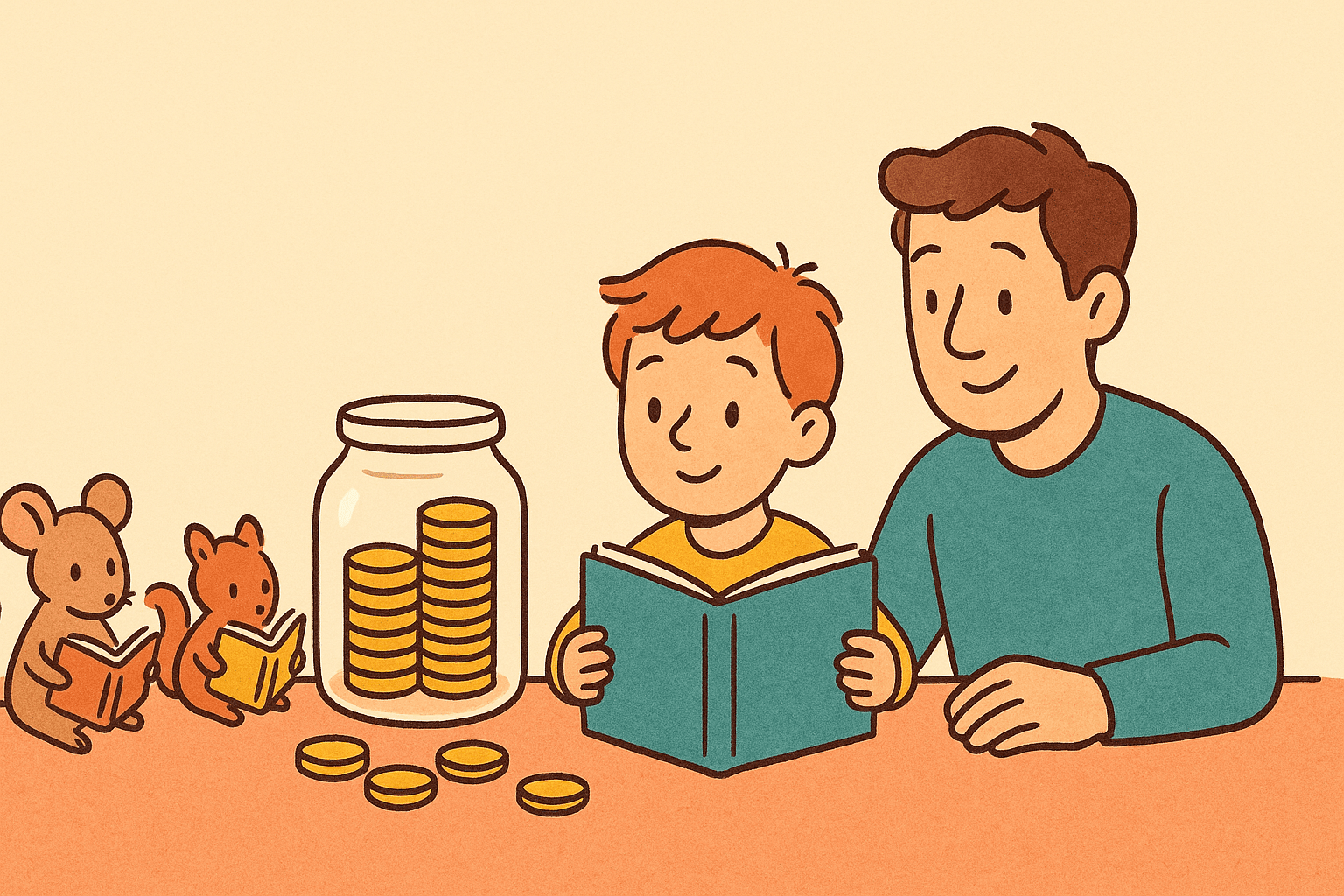
At five, money is not an idea. It's a thing you hold, a thing you trade, a thing that turns into other things. That's the beginning, and it's plenty.
Teaching a 5 year old the value of money doesn't mean explaining interest rates or scarcity. It means showing them that money has a job to do, that it runs out, and that choosing one thing means saying no to something else. Five-year-olds live in the now. They understand concrete better than concept. So we start there.
What a five-year-old can understand right now
A five-year-old can see the trade. You give coins, you get a book. You don't give coins, you don't get the book. The exchange is real and immediate. This is preschool money lessons at their simplest: money swaps for stuff.
They can also understand running out. If you have three coins and spend three coins, the coins are gone. Show them an empty hand. They get it. Empty means done. This is where Kay starts when teaching Leo about saving in our story Porfis, Porfis, Porfis. Leo wants everything. Kay shows him the pile of acorns (their stand-in for money) and asks what happens if he spends them all today. Leo looks at the empty pile. He connects the dots.
Five-year-olds also understand waiting, sort of. Not in the "save for college" sense, but in the "if you want the big toy, you can't buy the little toy today" sense. That's a version of delayed gratification they can actually picture. The big toy is right there on the shelf. They see it. They want it. You show them they don't have enough yet. That registers.
And they understand choice in a basic way. This or that, not both. You can frame it as a question: "Do you want the stickers or the ball?" They pick one. The other one stays on the shelf. Done. That's financial literacy age 5 style. One decision, visible outcome.
What's still too abstract (and that's fine)
Budgeting as a system? Too much. A five-year-old doesn't think in categories or percentages. They don't plan a week ahead. Trying to teach them to allocate money across "needs, wants, and savings" usually ends with a blank stare or them nodding just to move on.
Earning money through work is also murky at this age. They don't yet connect effort with reward in a reliable way. Sure, they can do a chore and get a coin, but the leap from "I worked, so I earned" to "I should work more to earn more" isn't automatic. Some kids get it early, but most don't until six or seven.
The idea that money has different values (a dollar buys less than five dollars, a quarter is worth more than a nickel even though the nickel is bigger) often doesn't click until they've handled money more. At five, size and quantity can still override value. That's normal. Let it come later.
Also too abstract: why we can't just make more money, why some things cost more than others, why we have to work to get money in the first place. These are great questions when they ask them, and you can give simple answers ("We trade our time and work for money," "Making more money makes it worth less"). But don't expect them to internalize it yet. They're collecting pieces. The picture forms slowly.
How to make it concrete (and keep it light)
Use real money when you can. Coins are better than bills for a five-year-old because they're easier to count and harder to lose track of. Let them hold the money, hand it to the cashier, wait for change. The physical act makes it real.
Play store at home. Set up a pretend shop with toys or snacks. Give them a pile of coins (buttons work too). They "buy" something, you take the coins, they see the pile shrink. Repeat until the pile is gone. Then say, "No more money, no more buying." They feel the limit. You can find more ideas like this in our activities section or by talking about money in everyday moments.
Let them make a mistake in a safe setting. If they blow all their coins on three small things and then want the big thing, let them sit with that feeling. Don't rescue it. Just say, "You spent your money. We'll have to wait until you have more." They might cry. That's the lesson landing. Next time, they remember.
Use clear either/or moments. "You have enough for one. Which one do you want?" No lectures, no guilt. Just the choice. They pick, they move on, they start learning that choosing costs something.
Keep the mood light. Money lessons at this age aren't serious sit-downs. They're quick moments woven into errands, play, snack time. If it feels like school, they check out. If it feels like a game or a little adventure, they stay curious.
When they ask the big questions
Five-year-olds ask why a lot. Why can't we buy that? Why do we have to pay? Why don't we have more money? These aren't philosophy debates. They're information requests. Keep your answers short and true.
"We can't buy that because we're using our money for other things today."
"We pay because someone made that, and they need money too."
"We have the money we have. If we want more, we work more, but we also choose carefully what we buy."
You're not solving their confusion in one answer. You're adding one true sentence to the pile. Over time, the pile makes sense.
Sometimes the question is really just frustration dressed up as curiosity. They want the thing. Explaining the economics of household budgets won't help. Acknowledge the feeling ("I know you really want it") and hold the boundary ("We're not buying it today"). That's enough.
What actually sticks at this age
The feeling of the trade. Money leaves, item arrives. That physical swap is the anchor for everything else.
The reality of empty. No money left means no buying left. They might not like it, but they understand it.
The weight of a choice. Picking one thing means not picking another. That tiny loss, that tiny win—it's the first draft of trade-offs.
And the memory of waiting and getting the thing. If they save (even just for a week) and then buy what they wanted, that success writes itself into their brain. They did it. It worked. They'll try it again.
Teaching a 5 year old the value of money isn't about covering all the concepts. It's about letting them bump into the edges of how money works, in small safe ways, so that by the time the concepts arrive, they already have the feel of it in their hands.
A little today, a lot tomorrow.
More from the blog
Money conversations
Wants vs needs: how to teach it to a child without lecturing
How do you teach wants vs needs for kids without the eye rolls? Concrete examples, fun activities, and zero sermons.
Money conversations
What to say when your kid asks for something expensive at the store
Practical scripts for talking to kids about price when they want an expensive toy. Turn the store tantrum into a calm money conversation with your child.
Money conversations
How to talk to kids ages 4 to 9 about money (without giving them the lecture)
A practical guide to starting real money conversations with young kids using stories, real coins, and simple questions. No formal lessons, no anxiety, no perfect-family budgeting required.