
The transparent jar - the first savings tool for kids ages 4 to 9
Why a glass jar teaches more about saving than a thousand explanations, how to set up the ritual at home, and what to do when your kid wants to open it too soon.
August 8, 2026 · 5 min read
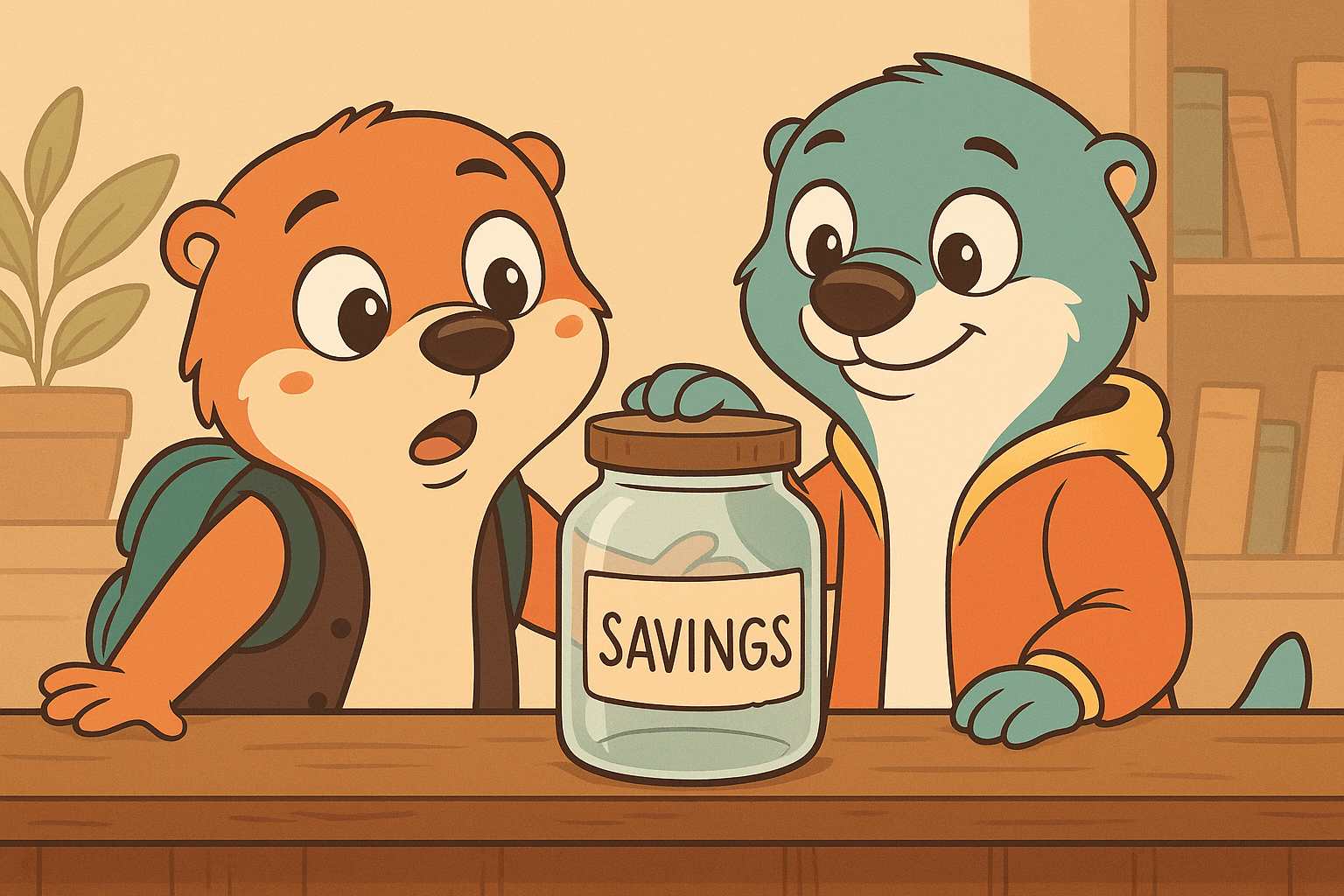
There's a reason Leo's jar (the same one on the hero image and on the cover of Please, Please, PLEASE, Can I Have It?) doesn't get swapped for a piggy bank, an app or a kids' bank account. A child ages 4 to 9 understands what they can see. A coin that lands in a glass jar makes a sound, has weight, takes up space. A coin inside an app is a number that appears and disappears.
This post is about setting up the ritual at home, without ceremony.
Why it works at this age
Between 4 and 9, a kid's thinking is concrete: they understand what can be touched, seen and counted. A number on a screen doesn't anchor learning. A coin that goes "clink" on its way in does. A jar that rises two fingers in a week teaches patience without the word patience ever showing up.
The jar is also honest. You can't pretend it's full when it's empty. It teaches, silently, that money is a real thing, not a promise.
How to set it up
Ten minutes, one afternoon. You need:
- A clear glass jar. A clean jam jar works perfectly. No opaque plastic — you lose the see-it-rise effect.
- A label with the wish written by the kid, not a number. The scooter, the book, the pencil set, whatever matters at their age.
- A lid that opens without a fight. Sabotage comes from what's forbidden.
- A visible spot in the house. The living-room shelf, not the back of a closet. The jar is a member of the household.
Minimum ceremony on day one: name of the wish, first coin in, optional photo. That's it. No contract, no thumbtacked "jar rules".
The weekly ritual
Pick one fixed day. In our house (and in Kay and Leo's) it's Saturday morning, when nobody is rushing. Three steps.
Take the jar out and put it on the table. Look at it.
Count what's there, out loud. Don't add anything new yet. Counting is the game.
Add, or don't. If money came in this week (a coin earned, a small gift, whatever), add it now. If not, no big deal. The jar doesn't grow every week and that's a lesson too.
Five to fifteen minutes depending on age. A four-year-old loves the ritual. A nine-year-old starts to care about the number.
When they want to open it too soon
It's going to happen. Let it happen, at least once.
If we forbid it, the jar turns into a bank vault and we lose the lesson. If we let them spend it badly, they learn something no adult can explain in words: an impulse purchase now blocks a better one later. That lesson is worth more than the coins that vanish into a toy that lasts three afternoons.
Kay has a line for these moments: "Wow… or worth it?". Ask it calmly, no trap face. If the kid says "wow", they buy the wow and next time they'll think about it differently.
When it fills up
This is the moment. Three simple rules.
Buy what the label said. Nothing else. The word given at the start is kept: the kid learns that saving is a promise, not a stockpile.
Do it together, slowly. Going to the store for what's in the jar is a small celebration. You count, you pay, you take it home.
Start over. New label, new wish. Saving isn't a project; it's a habit.
With more than one kid
In a house with two or three, one jar per kid, each with their own label colour. Don't compare how much each one has. The jar is a private relationship between a kid and their wish, not a race.
If there's a shared goal, add a family jar next to the individual ones. The personal ones stay untouched. The shared one grows slower and gets celebrated as a group.
When I skip a week
Nothing happens. The ritual survives pauses. What it doesn't survive is turning into an obligation with guilt attached. If a Saturday gets skipped, the next one picks it up.
When you're ready for the next step, we have a printable jar to colour so the kid can design their own to stick on. And if you want to go deeper on introducing these topics at home, the family zone has short ideas for lecture-free conversations.
A little today, a lot tomorrow.
More from the blog
Activities at home
Saving toward a goal with your kid: how to guide without pushing
Learn how to teach a kid to save for a goal without nagging. Practical ideas for purposeful saving that keep curiosity alive and build real habits.
Activities at home
Five coin games to play with your kid in ten minutes
Quick coin games for kids that teach counting, trading and patience. Grab a handful of change and play these five-minute math coin activities with your child.
Activities at home
How to make a homemade savings jar with your kid (step by step)
Learn how to make a savings jar for kids using things you already have at home. A fun craft that teaches money habits while you build together.